
SMOKE
The World is Burning but we fiction writers may sometimes welcome the smoke.

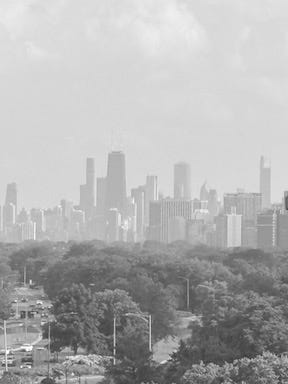
For the past week or ten days, I’ve lost count to be honest, Chicago has been crowned one of the worst air quality cities in the country (maybe the world? I was so demoralized I stopped reading). The now permanent Canadian Fires and the prevailing winds have not exactly conspired, because Nature doesn’t conspire, but merged to keep this fair city in a haze of smoke. Every morning the sun rises a neon pink, the skyline is a grayed blur and my lungs feel like they can’t quite catch a breath. I wake, sensing a weight has been laid on my chest. I have been constricted or reduced, somehow, overnight. It seems as if the lungs themselves have not rested, have not been able to idle through sleep at their usual low RPMs. The smoke in the atmosphere has kept them revved up overnight. They are tired.
Because they can’t. Catch a breath. And when we think of how much we use breath, how we depend on it not just for life but for calming ourselves, or taking a run, or expressing frustration or sadness (sigh), those poor lungs, overworked due to this haze that will not clear, gets pretty metaphoric pretty quick if you know what I mean.
And you probably do, because if you’re reading this, you’re a writer or a “creative” as we are now called, and you tend to think in images or metaphors or symbols.
There are those smoky rooms, or used to be. These spaces suggested sexy jazz and intrigue and duplicity of the attractive and irresistible kind. A convenient and much used setting that, for decades, was a standard trope in detective novels.
There’s the smoke and mirrors cliche, again the trickery, the unclear or unseen, the creepy feeling that we are being duped, that we cannot trust our senses. Something is afoot.
Blowing smoke: bullshitting, bragging, filling space with empty bombast.
And then there’s the actual smoke we voluntarily pull into our lungs to grab some nicotine or THC or cocaine. For a long time this was the epitome of cool and then devolved into its more rightful place as dangerous, lethal.
Whatever it is, smoke rarely ends up in the win column.
Speaking evolutionarily, smoke has been both friend and foe. When we finally figured out how to light that damn fire, the smoke kept our predators at bay, preserved our meat, and acted as an early GPS. Smoke was the price we paid for warmth and safety and community. For a long time, it was worth the price.
But as any fire fighter will tell you, smoke is also what’ll kill you. Heat and smoke. Fire you can see, hopefully run from. It has a location. Smoke is diffuse, it wanders at will, cloaking, coating, obscuring, really stinking up the place.
And now the world is burning.
In writing, smoke is a particularly operative image. If we are writing non-fiction, either creative or expository, we seek clarity, to wave the smoke from the room, to provide our readers with sharp edges, succinct questions, perhaps a vivid conclusion or two. We want the skyline to clear, the sun to be yellow, the horizon visible.
But we fiction writers may sometimes welcome smoke. We might call it craft, or subtlety, even obfuscation. We might like to disguise motives, keep characters alienated from others or themselves even. As a writer myself, I am sometimes interested in veiling a feeling or a relationship or an outcome. It’s one of the tools I use to keep the pages turning, to hold the reader captive in the world I am making. I am conjuring smoke, not waving it away.
In fiction, shouldn’t those hands which are waving the smoke out of the way to get a better view, to take a deeper breath, to be able to run with the narrative, shouldn’t those be the hands of a reader?
I’d like to believe that readers want the haze of uncertainty, the gray areas of what happens next, the whiff of something off in the distance that may be fire. They (or at least I think they) want to be the ones to clear the air.
Wow. Just, wow.
Like water, it creeps into us.
Like a breath, it never leaves us- it recycles and resumes us